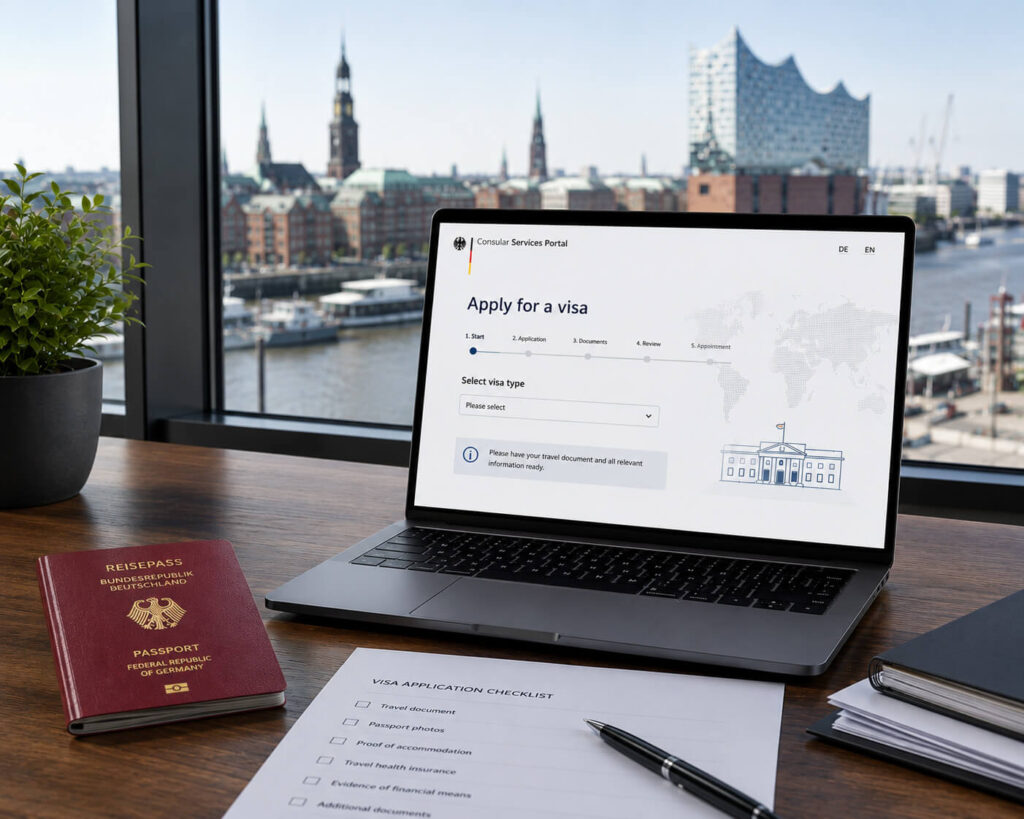
You can apply for a German self-employment visa if your proposed business meets the relevant immigration requirements, has secured financing and presents a credible economic case. For qualifying non-EU entrepreneurs, this route can make it possible to move to Germany and actively run a business. Registering or buying a company alone does not give you a right of residence.
Whether you want to launch a new venture, expand an overseas company or acquire an existing business, it helps to assess the immigration requirements before committing significant funds.
Jaberi Lawyers provides legal support for self-employment visas and business immigration in Germany, helping founders and active investors understand their options and prepare their applications.
What Is Germany’s Self-Employment Visa?
The term “self-employment visa” generally refers to the entry visa used to move to Germany for entrepreneurial or qualifying freelance activity. The corresponding residence permit is governed by Section 21 of the German Residence Act.
Whether you need an entry visa, and where you can apply for your residence permit, depends on your nationality and current residence status. If you already live in Germany, you should check whether your existing permit allows self-employment or requires further permission.
What Are the Requirements for Entrepreneurs?
Under the standard entrepreneurial route in Section 21(1), your proposed business must meet three central conditions:
- There is an economic interest or regional need for the activity
- The activity is expected to have positive effects on the economy
- Financing is secured through your own capital or a loan commitment
The authorities also consider the viability of your business idea, your entrepreneurial experience, the capital involved and the potential contribution to employment, training or innovation.
Your application should explain who your customers will be, why there is demand for your offering and how you intend to build a sustainable business. Financial projections and supporting documents should make those plans credible.
How Much Investment Is Required?
German law does not set one universal minimum investment amount for every self-employment application under Section 21(1). The financing must be sufficient to implement your particular business concept.
A consultancy may need less initial capital than a restaurant, retail operation or manufacturing company. Your financial plan should account for the costs of establishing and operating the business, alongside your personal living expenses.
Rather than focusing on a single investment figure, prepare evidence showing where the money comes from, how it will be used and why your forecasts are realistic.
Can You Get Residence by Buying a Business?
Buying an existing German company may form part of a business immigration application. However, the purchase itself does not establish a right of residence.
The authorities still assess the proposed activity against the applicable requirements. Your intended operating role, entrepreneurial experience, financing and the company’s prospects all help explain the case. A passive investment alone should not be assumed to qualify you for an entrepreneurial residence permit.
Before signing a purchase agreement, consider how the acquisition fits your immigration strategy.
Which Documents Do You Need?
The exact checklist depends on your circumstances and the responsible German mission or immigration authority. Commonly requested documents include:
- A valid passport and completed application forms
- A business plan covering your concept, market and commercial strategy
- Financial forecasts and proof of secured funding
- Your CV, qualifications and relevant professional experience
- Supporting contracts, business contacts or letters of intent where appropriate
- Proof of health insurance and sufficient means to support yourself
- Any necessary professional permissions
- Evidence of adequate pension provision where applicable
Consistency matters. Your business plan, funding documents and professional background should support the same proposed activity. Unexplained differences can leave important questions unanswered.
Is a Freelancer Visa Different?
Yes. Qualifying freelance professionals may apply under Section 21(5), which differs from the standard entrepreneurial route.
Germany distinguishes between commercial business activity and liberal professions, known as freiberufliche Tätigkeit. The correct classification depends on the work you intend to perform.
Freelance applicants generally need to demonstrate that they can finance their activity and support themselves. Professional permission is also required where the occupation is regulated.
Confirming the appropriate route early helps you prepare the right documents.
Can Self-Employment Lead to Permanent Residence?
Qualifying entrepreneurs may be eligible to apply for a settlement permit after three years under Section 21(4). This requires, among other conditions, evidence that the business can continue developing sustainably and that sufficient income secures the livelihood of the applicant and relevant family members.
Approval is not automatic. The same three-year provision does not apply to freelance permits under Section 21(5).
Get Your Business Immigration Plans Assessed
Your business idea is the starting point. A well-prepared application connects that idea with credible funding, relevant experience and evidence addressing the immigration requirements.
Jaberi Lawyers supports international founders and active investors with feasibility assessments, immigration strategy, business plan legal review and application preparation.
Planning to start, expand or acquire a business in Germany? Request a confidential assessment of your business immigration options and share your proposed venture, funding position and timeline with our team.
This article provides general information. Your eligibility and application requirements depend on your individual circumstances.